Peer Review Policy
Review Type: Double-Blind Peer Review
Solutions in Social and Management Sciences employs a rigorous double-blind peer review process for all submitted manuscripts. Under this model, the identities of both the authors and the reviewers remain confidential throughout the entire review process. Authors do not know who reviewed their work, and reviewers do not know the identity of the authors whose work they are evaluating. This approach ensures objectivity, impartiality, and the highest standards of academic integrity in the evaluation of all submissions.
Scope of Peer Review
All original research articles, systematic reviews, meta-analyses, case studies, and policy-oriented papers submitted to SSMS are subject to double-blind peer review prior to acceptance for publication. Submissions are not published unless they have successfully completed the full peer review process and received editorial approval. Invited editorials and corrections to published work are reviewed at the discretion of the Editor-in-Chief.
Review Process
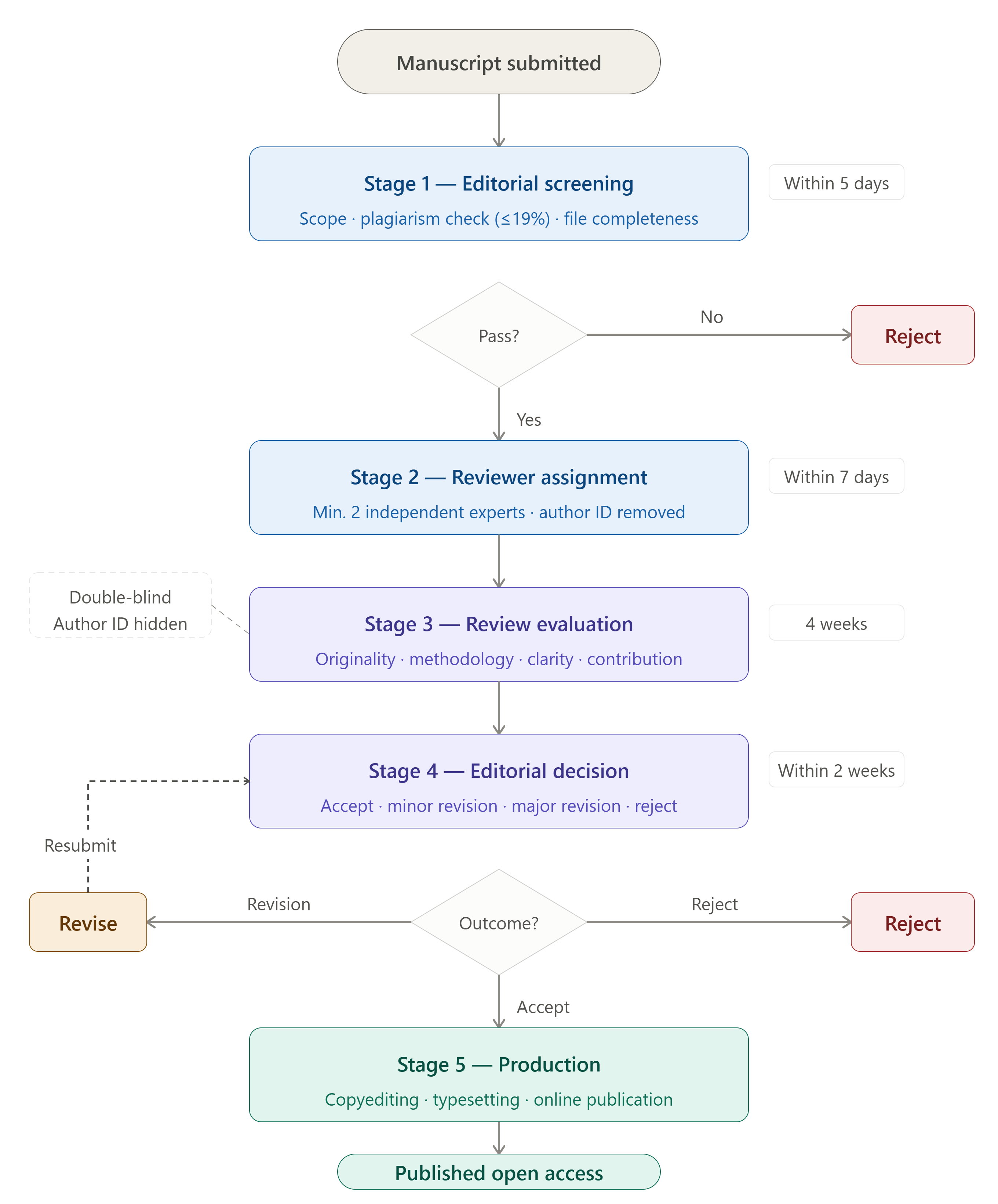
Stage 1 — Editorial Screening
Upon submission, the Managing Editor conducts an initial screening of all manuscripts within five working days. At this stage, submissions are assessed for the following:
Alignment with the journal's aims and scope; compliance with the submission preparation checklist and author guidelines; English language standard sufficient for review; originality screening using iThenticate (similarity index must not exceed 19%); and completeness of all required files including a title page submitted separately to facilitate blind review.
Manuscripts that do not pass this initial screening are returned to the authors with an explanation. Manuscripts that pass screening proceed to the double-blind peer review stage.
Stage 2 — Reviewer Assignment
The Editor-in-Chief or a designated Section Editor assigns each manuscript to a minimum of two independent expert reviewers. Reviewers are selected on the basis of their subject expertise, publication record in the relevant field, and absence of conflicts of interest with the authors or their institutions. The journal actively seeks reviewers from diverse geographic regions and institutional affiliations to ensure international perspectives in the evaluation process.
All author-identifying information is removed from the manuscript file before it is sent to reviewers. Authors are required to ensure that their manuscript file contains no self-identifying references, acknowledgements, or institutional identifiers in the main text.
Stage 3 — Review Evaluation
Reviewers are asked to evaluate manuscripts against the following criteria: originality and significance of the contribution to the field; clarity and appropriateness of the research question or objectives; rigour and soundness of the methodology; accuracy and interpretation of results or analysis; quality and relevance of the literature review; and clarity, organisation, and language of the manuscript.
Reviewers submit one of the following recommendations: Accept as submitted; Minor revisions required; Major revisions required; Reject and resubmit; or Reject.
Reviewers are requested to complete their evaluation within four weeks of accepting the review invitation. Where a reviewer is unable to complete the review within this period, the editorial team will seek an alternative reviewer to avoid undue delays to authors.
Stage 4 — Editorial Decision
Following receipt of reviewer reports, the Editor-in-Chief or handling Section Editor makes one of the following decisions: Accept; Minor revision; Major revision; Reject. The editorial decision is communicated to the corresponding author along with the anonymised reviewer comments. In cases where reviewer recommendations conflict, the Editor-in-Chief may seek a third review or make a final determination based on editorial judgement.
Stage 5 — Revision and Resubmission
Authors invited to revise their manuscript must submit a revised version accompanied by a detailed response letter addressing each reviewer comment point by point. Minor revisions are expected within three weeks. Major revisions are expected within eight weeks. Revised manuscripts may be returned to the original reviewers for further evaluation.
Stage 6 — Final Decision and Production
Once a manuscript is accepted, it enters the production queue for copyediting, typesetting, and online publication. The corresponding author is notified of the acceptance and expected publication timeline.
Review Timeline
| Stage | Target timeframe |
|---|---|
| Initial screening decision | Within 5 working days |
| Reviewer assignment | Within 7 working days of passing screening |
| Reviewer evaluation period | 4 weeks |
| Editorial decision communicated | Within 2 weeks of receiving all reviewer reports |
| Minor revision resubmission | 3 weeks |
| Major revision resubmission | 8 weeks |
| Target time from submission to first decision | 6–8 weeks |
Confidentiality
All manuscripts under review are treated as confidential documents. Reviewers must not share, discuss, or disclose the content of any manuscript under review with any third party without the explicit written permission of the Editor-in-Chief. Reviewers must not use unpublished data, arguments, or interpretations from manuscripts under review for their own research prior to publication.
Conflicts of Interest
Reviewers who identify a conflict of interest with the authors, institution, or subject matter of a manuscript under review must immediately notify the editorial team and decline the review. Conflicts of interest include but are not limited to: current or recent collaborative relationships with any author; competitive or adversarial relationships; financial interests in the research outcomes; and institutional affiliations that could compromise objectivity.
Editors who have a conflict of interest with a submitted manuscript recuse themselves from all editorial decisions relating to that submission. Editorial decisions are made exclusively by editors who have no conflict of interest.
Appeals
Authors who believe an editorial decision was based on a factual error, a misunderstanding of the research, or a procedurally improper review may submit a formal appeal to the Editor-in-Chief at ssms@sp-research.org. Appeals must be submitted within four weeks of the editorial decision and must include a detailed written justification. The appeal will be reviewed by an independent editor or associate editor not previously involved in the submission. The outcome of the appeal process is final.
Editorial Independence
All editorial decisions at SSMS are made on the basis of academic merit alone. The publisher, Sociopolicy Research Solutions (Pvt.) Ltd., does not interfere in editorial decisions. Authors affiliated with the publisher or the editorial board are subject to the same peer review process as all other authors and must not be handled by editors with whom they have a direct relationship.
Compliance
This peer review policy is compliant with the guidelines of the Committee on Publication Ethics (COPE) and the Directory of Open Access Journals (DOAJ). SSMS is committed to continuous improvement of its peer review practices and reviews this policy annually.
For queries regarding the peer review process, contact the editorial office at ssms@sp-research.org.